
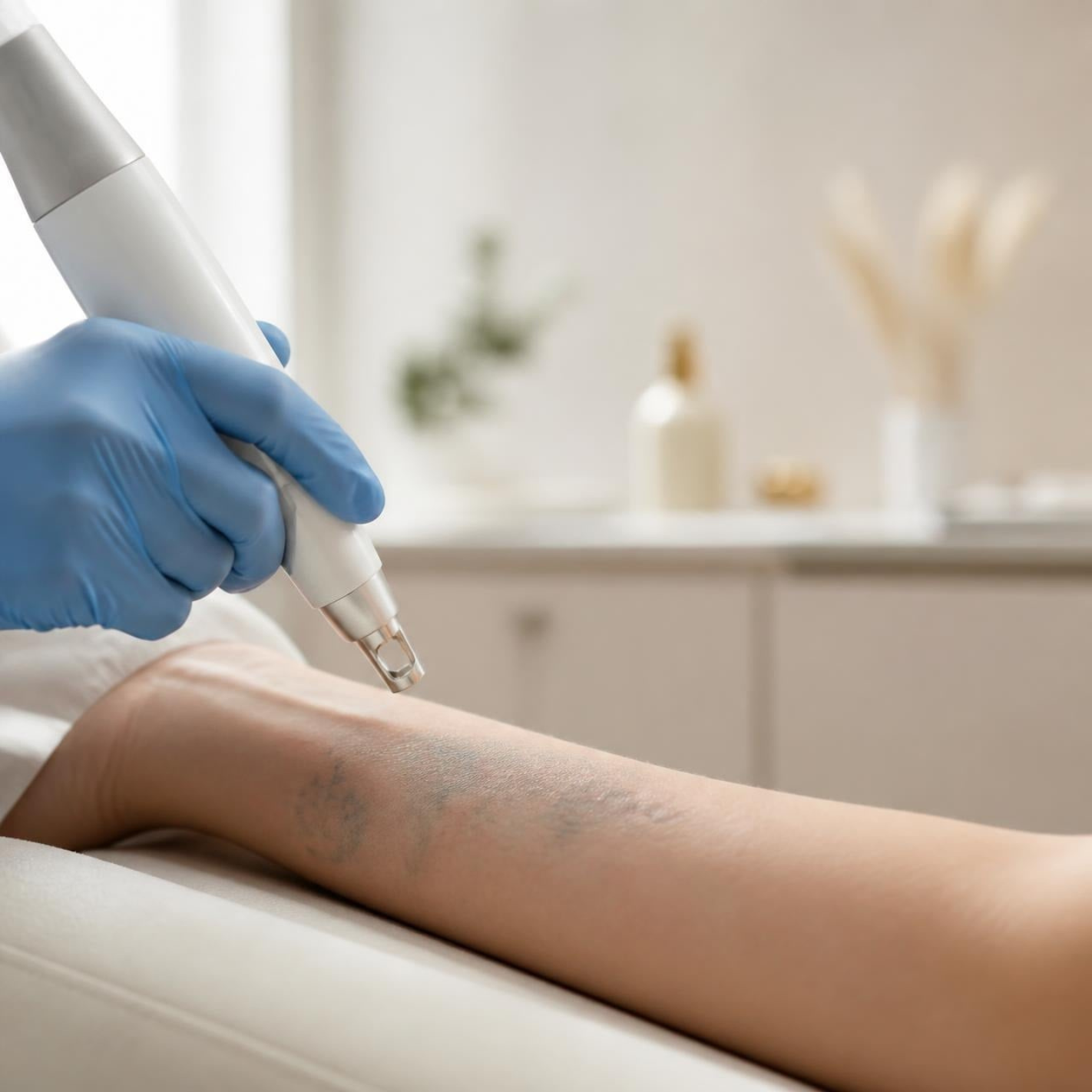
Laser Tattoo Removal in Walnut Creek
I am Dr. Kourosh Moazemi, and I perform laser tattoo removal at Beau Visage Aesthetics with the Q-switched Nd:YAG 532/1064nm handpiece on the Rohrer Aesthetics Spectrum platform. I begin by examining the tattoo and your skin. If I am not confident that our laser is suited to the tattoo, I will tell you.
23+ YEARS EXPERIENCE | BOARD CERTIFIED MD | FORMER ASST. PROFESSOR OF MEDICINE | 5.0★ ACROSS 136 REVIEWS
How Q-Switched Nd:YAG Tattoo Removal Works
Tattoo pigment remains visible because ink particles are too large for the body to clear efficiently. A Q-switched laser delivers energy in nanosecond pulses. When the correct wavelength is absorbed by a tattoo pigment, the rapid energy pulse breaks larger ink particles into smaller fragments. The immune system gradually carries away part of that fragmented pigment during the weeks after treatment.
The laser does not extract the ink, and more energy is not automatically better. The treatment settings must balance pigment disruption against the risk of injuring surrounding skin. Each session is followed by a healing and clearance period before the tattoo can be reassessed.
Why 532nm and 1064nm Wavelengths Matter
Tattoo colors absorb different wavelengths of light. The Spectrum handpiece provides two Q-switched Nd:YAG wavelengths:
- 1064nm is commonly used for black and other dark pigments. It penetrates more deeply and interacts less with epidermal melanin than shorter wavelengths, which can make it the more suitable starting wavelength for many clients with darker skin types.
- 532nm is commonly used for selected red and warm-colored pigments. Because melanin also absorbs more energy at 532nm, treatment requires particular caution in more deeply pigmented skin.
Two wavelengths do not make every ink color equally treatable. bright colors of green, turquoise, blue, yellow, white, flesh-tone, and certain cosmetic pigments may respond poorly, require a wavelength not available on this platform, or darken unexpectedly.
What to Expect During Tattoo Removal
The laser is passed over the tattoo in a controlled pattern. Many clients describe the sensation as repeated hot snaps against the skin. Comfort varies with tattoo location, size, pigment density, treatment settings, and individual sensitivity.
Immediately afterward, temporary whitening or frosting may appear. Redness, swelling, warmth, pinpoint bleeding, or blistering can follow. A dressing or ointment may be recommended depending on the treatment response. The treated area then heals while pigment clearance continues over the following weeks.
How Many Tattoo Removal Sessions Will I Need?
There is no responsible way to promise an exact number before seeing how a tattoo responds. Many professional tattoos require six to ten or more treatments. Amateur tattoos or less-dense black ink may respond in fewer sessions. Large, densely layered, multicolored, distal-extremity, cover-up, or previously treated tattoos may take longer.
Clinical studies of Q-switched 532/1064nm systems illustrate this variability. One 52-patient study reported a mean of 4.6 treatments, with treatments performed up to nine times and at least eight weeks apart. A larger prospective cohort found successful removal in 47.2% after 10 sessions and 74.8% after 15 sessions under that study’s definition. These figures describe study populations, not a forecast for an individual tattoo.
Treatments are commonly separated by at least four to eight weeks so the skin can heal and the body can continue clearing fragmented pigment. Treating too frequently does not allow those processes to finish and may increase risk.
Can a Tattoo Be Completely Removed?
Some tattoos can become difficult to see. Others can be substantially faded but remain visible. Complete removal cannot be guaranteed.
Black and selected red pigments generally respond more predictably to the two wavelengths available on the Spectrum handpiece. Resistant colors, dense professional ink, scarred tattoos, cover-up layers, pigment depth, and tattoo location can limit clearance. Permanent makeup and pigments containing titanium dioxide or iron oxide may darken when treated and require a different plan.
If your goal is a cover-up rather than complete removal, fewer sessions may be enough to give the tattoo artist a lighter field. We should define that goal before treatment so the plan is not more extensive than necessary.
Tattoo Removal for Different Skin Types
Laser tattoo removal can be performed across a range of skin types, but the settings and wavelength choice require additional care when the skin contains more pigment. The 1064nm wavelength is often favored for dark ink in darker skin because it is absorbed less by epidermal melanin than 532nm. That does not eliminate the possibility of temporary or lasting lightening or darkening of the skin.
The 532nm wavelength may be useful for selected warm pigments, but it also has greater interaction with melanin. The decision to use it depends on the pigment, skin type, recent sun exposure, and the expected balance of benefit and risk. A test spot or a more conservative approach may be appropriate.
Risks, Healing, and Aftercare
Expected short-term effects can include redness, swelling, tenderness, pinpoint bleeding, crusting, and possibly blistering. Possible complications include infection, scarring, changes in skin texture, temporary or permanent hypopigmentation or hyperpigmentation, incomplete pigment clearance, allergic or inflammatory reactions to fragmented ink, and paradoxical darkening of certain cosmetic pigments.
Sun exposure increases the difficulty of treating skin safely and can worsen pigment changes. Protect the area from sun before and after treatment, do not pick crusts or open blisters, and follow the wound-care instructions you receive. The American Academy of Dermatology advises protecting treated skin from the sun for three months after laser tattoo removal.
Keep the treated area clean and protected from the sun, do not pick crusts or open blisters, and follow the written instructions you receive at your visit. Contact the office promptly if pain, redness, drainage, or swelling is worsening rather than improving.
Full pre- and post-treatment instructions are on our Tattoo Removal Care page.
What Does Laser Tattoo Removal Cost?
Tattoo removal is priced per session, and the total depends on the tattoo’s size, colors, ink density, location, and how many sessions it ultimately needs. At Beau Visage Aesthetics, sessions start at $150, and most small-to-medium tattoos fall between $150 and $350 per session. Consultations are complimentary. An honest estimate explains both the per-session price and the uncertainty in the number of sessions — a low session price does not establish the total cost if the tattoo needs a longer course.
Laser Tattoo Removal FAQs
Start With an Honest Assessment
I will examine the tattoo, identify the colors and factors likely to affect its response, and explain what the Spectrum 532/1064nm system can reasonably accomplish. We will decide whether the goal is meaningful fading, preparation for a cover-up, or the clearest result the available wavelengths are likely to provide. If the tattoo is not a good match for this treatment, I will tell you.
Reviewed and approved by Kourosh Moazemi, MD, FACP, board certified in Internal Medicine. Last reviewed September 9, 2026.