
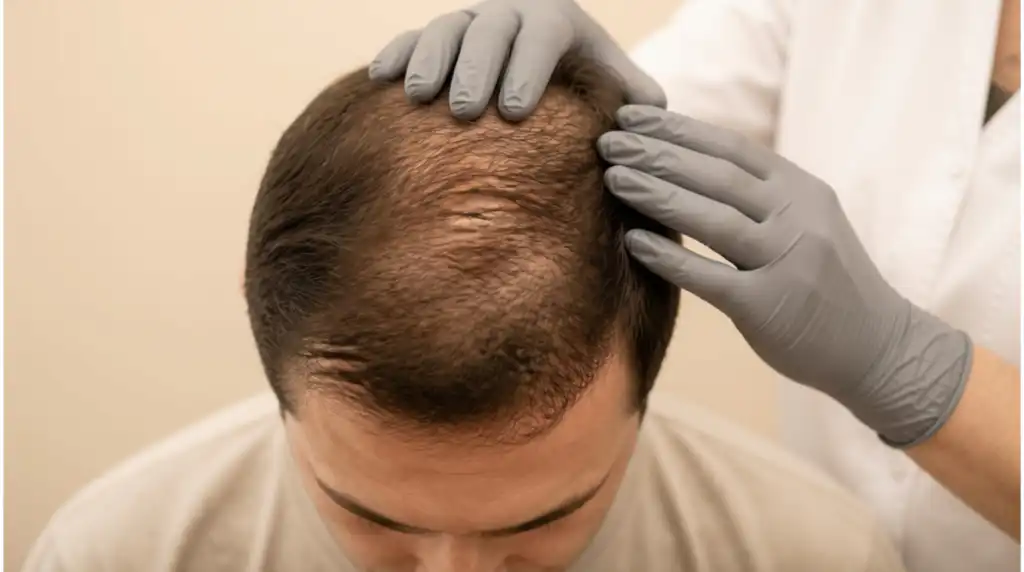
Platelet-rich plasma, or PRP, starts with your own blood. It is spun to concentrate the platelets, then that platelet-rich portion is returned to the scalp.
People often ask me whether PRP works for hair loss. The honest answer is that it helps most people to a measurable degree, but it does not help everyone. The research points in a positive direction, with important limits that deserve as much attention as the encouraging results.
I am a board-certified physician. Before I treat hair loss, I begin with a medical work-up so that we are not overlooking a cause that may need a different answer.
What the Research Shows
Papakonstantinou and colleagues pooled 11 randomized trials. Compared with placebo, PRP injections increased follicle count, hair thickness, and hair density. The reported side effects were temporary and minor, including localized pain, bleeding, and itching. [1]
Morkuzu and colleagues reviewed 29 studies involving 864 people. Twenty-seven studies reported benefit. In the pooled analyses, density increased by about 46.5 hairs per square centimetre from baseline, and by about 31.6 hairs per square centimetre compared with control groups. The studies varied considerably, which makes those averages less certain than they first appear. [2]
Yuan and colleagues examined 21 studies involving 628 women. PRP produced higher hair density and greater thickness overall. Results varied with dose, treatment timing, and ethnicity. The review also found mild, short-lived side effects, with no clear difference in pain or discomfort compared with control treatment. [3]
Yao and colleagues analyzed five randomized trials comparing minoxidil alone with minoxidil plus PRP. The combination produced greater density at one month, three months, and five or six months. The authors rated the certainty of that evidence low to very low because the studies were small, several had a high risk of bias, and PRP preparation methods differed. [4]
Ozcan and colleagues randomly assigned 62 men to PRP delivered with microneedling or by point-by-point injection. Both methods improved hair count, density, terminal hair count, and terminal hair density from baseline. Microneedling did better on anagen hair, telogen hair, and average hair length. [5]
Shapiro and colleagues conducted a placebo-controlled split-scalp trial in 35 people. Density on the PRP side rose by about 20 hairs per square centimetre. Density also rose on the saline side, however, and the difference between the two sides was not statistically significant. [6]
Taken together, the signal is positive but modest. The studies use different preparations, doses, and schedules. PRP is an addition to established options such as minoxidil and finasteride, not a replacement for them. It does not work for everyone.
How I Use It
I start with a medical work-up, including thyroid and sex hormones, because hair loss can have a treatable cause. I consider PRP for men and women whose hair loss has accelerated. We decide together whether it belongs in your plan.
I deliver PRP in one of three ways, chosen at the consultation: applied with microneedling, injected into the scalp, or both. I usually combine it with minoxidil or finasteride when either suits the person, with other topical options considered where appropriate. The usual starting course is three monthly sessions. If we see enough improvement, maintenance is one session every six to twelve months.
About one in five people do not improve enough to continue. If that is what I see, I will say so instead of selling you a fourth session. When a surgical transplant is the right answer, I refer out.
What to Expect
A session takes about an hour. We draw your blood, prepare the PRP, then treat the scalp. You may have tenderness and pinpoint bleeding for a day or two. Most people have no downtime beyond that.
I usually judge the first meaningful change at about three months. That timing is a checkpoint, not a promise. Hair responds slowly, and the decision to continue depends on what we can actually see.
PRP for Hair Loss: Questions
Talk It Through First
If you are considering PRP for hair loss, I begin with a consultation. We will look at the pattern, the pace of loss, and the possible causes, then decide together whether PRP belongs in your plan. The consultation is $150, waived if you proceed with treatment.
You can read more about the work-up, treatment plan, and available options on our hair restoration page.
References
- Papakonstantinou M, et al. 2023. Plastic and Reconstructive Surgery. Autologous Platelet-Rich Plasma Treatment for Androgenic Alopecia: A Systematic Review and Meta-Analysis of Clinical Trials. Delivery: injections.
- Morkuzu S, et al. 2023. Aesthetic Surgery Journal. Use of Activated Platelet-Rich Plasma (A-PRP) on Alopecia: A Systematic Review and Meta-Analysis. Delivery: injections.
- Yuan J, et al. 2024. Skin Research and Technology. Effectiveness of Platelet-Rich Plasma in Treating Female Hair Loss: A Systematic Review and Meta-Analysis of Randomized Controlled Trials. Delivery: not stated in the PubMed abstract.
- Yao J, et al. 2024. PLOS ONE. The Additive Value of Platelet-Rich Plasma to Topical Minoxidil in the Treatment of Androgenetic Alopecia: A Systematic Review and Meta-Analysis. Delivery: not stated in the PubMed abstract.
- Ozcan KN, et al. 2022. Dermatologic Therapy. Platelet Rich Plasma Application by Dermapen Microneedling and Intradermal Point-by-Point Injection Methods, and Their Comparison with Clinical Findings and Trichoscan in Patients with Androgenetic Alopecia. Delivery: microneedling and point-by-point injection.
- Shapiro J, et al. 2020. Journal of the American Academy of Dermatology. Evaluation of Platelet-Rich Plasma as a Treatment for Androgenetic Alopecia: A Randomized Controlled Trial. Delivery: intradermal injection.
- Roohaninasab M, et al. 2021. Dermatologic Therapy. Systematic Review of Platelet-Rich Plasma in Treating Alopecia: Focusing on Efficacy, Safety, and Therapeutic Durability.
- Davies C, et al. 2025. Periodontology 2000. Autolougous Platelet Concentrates in Esthetic Medicine.